
The IPQ Field Guide
Facebook ads for architects
Ask an architect about Facebook ads and you get the same answer every time: "My clients aren't on there." They are. They're on there right now, looking at somebody else's kitchen.

This one belief is the most expensive assumption in the profession. The homeowner with a $3M budget is not too sophisticated for Instagram. She's on it every night, saving renovations, following designers, redesigning her house in her head. The only real question is whether the work she keeps seeing is yours or the firm's down the road.
One note on names before anything else, because it trips people up. Facebook ads and Instagram ads are the same buy. Both run through Meta's ad system, off one account, with one budget and one set of targeting, which is why you will see this channel called Meta ads. Everything below applies to both.
The short answer
Meta ads work for architects because Facebook and Instagram let you put finished projects in front of the exact buyers in your metro, homeowners planning a build if you do residential, developers and business owners if you do commercial, before they ever search for an architect. Target by location, income, and interest, run creative that shows real work, put a clear offer behind the ad, then follow up. Same engine for both markets, different aim. Across 21 architecture firm accounts we ran over the past year, the median firm paid $50 a lead and $148 per booked consultation.
Before the how, one piece of evidence. A single-family project worth sixty million dollars came from one image ad and a Facebook form. No landing page, no funnel, no retargeting sequence. A form. Eric from KDA tells that story himself:
That is the ceiling, not the average, and nobody should plan around it. It is here to kill one specific objection: the belief that the people with real budgets are somehow not reachable in a feed.
The objection is checkable, so we checked it
"Wealthy people aren't on Facebook" is a claim about the population, and somebody already counts that. The Pew Research Center's social media fact sheet surveys US adults on the platforms they use and publishes the breakdown by household income. Its survey ran from 5 February to 18 June 2025.
| US household income | Use Facebook | Use Instagram |
|---|---|---|
| Under $30,000 | 71% | 41% |
| $30,000 to $69,999 | 72% | 46% |
| $70,000 to $99,999 | 72% | 54% |
| $100,000 and over | 71% | 60% |
| All US adults | 71% | 50% |
Facebook does not care how much your buyer earns. It sits at 71 or 72 percent in every bracket, including the top one. Instagram does move with income, and it moves the wrong way for the people making this argument: 41 percent at the bottom of the scale, 60 percent above $100,000. The households most likely to commission an architect are the ones most likely to be on Instagram.
That is the whole objection, settled with somebody else's data. The buyers are there. Whether they ever see your work is a budget and targeting question from here on.
Why Meta actually works for architecture
Architecture is one of the rare businesses where the product photographs like a magazine cover. Meta is a machine built to show beautiful images to specific people. That is not a coincidence worth ignoring. And the targeting is the part that should make you a little uncomfortable, in a good way.
You can put your work in front of homeowners in one set of zip codes, above a certain income, who have spent the last month deep in renovation and luxury-property content, or in front of the developers and business owners who sign off on commercial work in the same metro. There is nowhere else you can be that precise about who sees your portfolio.
Who you're actually reaching
You're not advertising to "everyone on Facebook." You're advertising to the narrow slice that matters: in your metro, high-income homeowners showing every sign of someone about to start a project if you do residential, or the developers and business owners with something taking shape if you do commercial.
The platform already knows who's been browsing home design, who just bought a property, who follows builders and architects. How that residential buyer thinks, and how to win them early, is the whole of marketing for residential architects.
Point your ads at exactly those people, before they've typed a single word into Google. By the time they would have started searching, they already know your name. (The searches themselves are a smaller, pricier game, broken down with real click prices in Google Ads for architects.)
Residential and commercial: same platform, different play
Residential is where Meta is most obviously lethal. A homeowner saving kitchens at midnight is the easiest high-value buyer on earth to reach here. But "Meta is just for residential" is the second most expensive assumption in the business. The people who sign off on commercial work, developers and business owners, are on Facebook and Instagram too, and you can put your firm in front of them with the same precision.
What changes is the creative and the angle, not the channel. For commercial you point the targeting at the decision-makers, lead with returns and proof (the building that paid for itself, the project delivered on time and on budget), and retarget the people who already looked so you stay in front of them through a long buying cycle.
The "imagine your dream home" angle that melts a homeowner does nothing for someone reading a P&L. Sell the return, not the feeling. Same platform, opposite pitch. More on that buyer in marketing for commercial architects.
The creative that works (and the kind that quietly flops)
Here is the part that annoys people who like making things complicated. Across more than seventy campaigns for architecture firms, the thing that typically wins for us is almost insultingly simple: one photograph of a finished project, with a line of text over it asking something like "Planning to build or renovate?" That is the whole creative. More often than not it outperforms the carousels, the polished brand films, and the clever copy.
The reason it wins is that it filters instead of impressing. A person who is genuinely planning a project stops on a house that looks like the one in their head and answers a direct question. Everyone else scrolls past, which is exactly what you want, because you pay for the scroll either way.
None of which makes it a law. Video crushes it plenty of times, and a walkthrough of a finished house can be the best ad in the account, which is the case made in video marketing for architects.
Treat the simple photo as the thing to beat rather than the thing you are stuck with. Start there because it wins most often, then put your video up against it and let the numbers settle the argument. (The one creative that loses reliably: a clip-art blueprint above the words "QUALITY YOU CAN TRUST.")
Here are three of ours that are running right now, with what they actually produced.


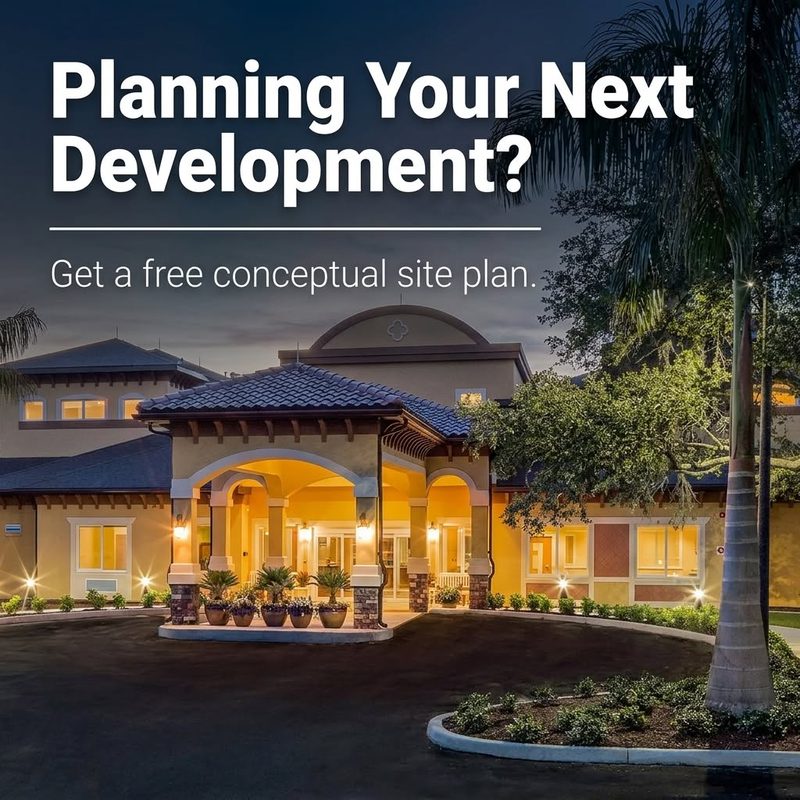
Notice what they have in common. One photograph of real work. One direct question aimed at someone already thinking about a project. One specific free thing on the other side of the click. No slogans, no mission statement, no logo doing the heavy lifting.
The commercial one is the same machine with the question swapped. "Planning your next development?" and a free conceptual site plan, pointed at developers instead of homeowners, for a building rather than a house. Same template, different buyer.
Show the outcome, not the process. The client does not lie awake dreaming about construction documents. They dream about the light, the space, the house their friends can't stop complimenting. Sell that.
Targeting: the setting most firms get backwards
Most people burn their first month fiddling with interest targeting, stacking "luxury homes" and "architectural digest" and "home renovation" on top of each other, convinced the audience builder is where the campaign is won. Across our campaigns the setup that consistently wins is close to no targeting at all: Advantage+ audience, ages thirty-five to sixty-five plus, the geography you actually serve, and nothing else. No interests. No stacked behaviors.
For high-end residential there is one layer worth adding, household income in the top five or ten percent. If you want to go further, build a ZIP list from property values and target the top three to five percent. That is a real edge in expensive metros.
But hold the proportions in your head: roughly eighty percent of the result is the creative and how precisely it speaks to the person you want. Meta now reads your image and your copy to decide who should see the ad, far more than it reads your audience settings. A great photo with lazy targeting outperforms a surgical audience wrapped around a boring ad, more often than not.
Give them a reason to act
A bare "Contact us" link converts at roughly nobody. Nobody scrolling at 11pm is going to cold-email a firm for the fun of it. You need a real offer behind the ad, and there are two systems that work here. They're just different, not better or worse.
The first is low-friction. You give them an easy yes: a consultation, a project planning guide, a quick way to find out if their idea is even feasible. The ad's job there isn't to win the project, it's to start the conversation, and you win the project later, in a room. It pulls more volume, including people still early in their thinking.
The second is direct response. You make a stronger, more direct ask, like booking a call straight off the ad. Fewer people put their hand up, but the ones who do are more serious and further along. You trade volume for intent.
| How they differ | Low-friction offer | Direct response |
|---|---|---|
| The ask | An easy yes: a consultation, a planning guide, a feasibility check | Book a call, straight off the ad |
| Volume | More hands up, including people still early in their thinking | Fewer, further along |
| Intent | Mixed. You win the project later, in a room | Higher. They came to talk |
| Fits when | You want a full calendar and can work the list | You want fewer, hotter conversations |
Which one fits depends on your market, your offer, and how much volume you want your team working. The only real mistake is the thing in between: an ad pointing at a portfolio with no offer and no obvious next step at all. The landing side of that handoff, what the page behind the click has to say before a stranger will hand over their name, is covered in website design for architects.
Then actually follow up
Most people who show interest won't book that same day. They have a job, a family, and a project they're equal parts thrilled and terrified about. The firms that win are not the ones with the cleverest ad. They're the ones that follow up like adults instead of sending one email and deciding silence means no.
A good chunk of booked projects come from the fourth or fifth touch, long after most firms gave up. The sequences that do the waiting for you are in email marketing for architects, and the physical version for the warmest names is direct mail for architects.
Where the money quietly dies
- The boost button. Boosting a post is how Meta separates architects from their budget in exchange for likes from people who will never hire them.
- Targeting "everyone within 25 miles," then wondering why the leads can't afford you.
- Sending ad clicks to a homepage portfolio with no next step, so the click you paid for just admires your photos and leaves.
- Judging ads by likes and reach instead of booked consultations. Reach doesn't pay payroll.
- Killing an ad after three days because it "didn't work." It didn't have time to.
What it actually costs, with real numbers
Most articles about this refuse to print a number. Here are ours, from 21 architecture and design firm Meta accounts we ran between 15 September 2025 and 11 September 2026: $117,656 of spend and 2,419 leads. The full method, quartiles and all, is in our architecture marketing benchmark report.
| What we measured | Cost |
|---|---|
| Cost per lead, median firm | $50 |
| Cost per lead, middle half of firms | $28 to $71 |
| Facebook lead form campaigns (39 campaigns) | $40.55 per lead |
| Landing page campaigns (9 campaigns) | $70.18 per lead |
| Residential accounts (7) | $39.92 per lead, $114.65 per booked consultation |
| Commercial accounts (3) | $53.43 per lead, $123.63 per booked consultation |
| Cost per booked consultation, median firm | $148 |
Plan on the median, not on the best case. The best case is real and it is a lot cheaper: our strongest residential campaigns, run across several states on a lead form, come in at $15 to $20 a lead, which is where the Fletcher and Dwelling ads above sit. The same ad aimed at one or two cities costs roughly 1.5 to 2 times that, because you are fishing a smaller pond and the algorithm has fewer people to pick from.
The gap between forms and landing pages is the trade you are making, on purpose. Meta fills a form in for the user, so across our accounts form leads came in about 40 percent cheaper, and 78 percent of all our leads arrived that way. You pay for the convenience in quality. A landing page makes people work a little, which thins the herd and leaves you talking to buyers who are further along.
The commercial line is worth sitting with. A commercial lead cost about a third more than a residential one. Then 43 percent of those leads booked a consultation, against 35 percent on the residential side, so the two land within nine dollars of each other per booked meeting. A firm reading only the cost per lead column concludes commercial is expensive to market, and the booking column says otherwise.
Three accounts is three accounts, so treat it as a direction rather than a rule. More on that buyer in marketing for commercial architects.
How our numbers sit against an outside benchmark
Our figures are worth more with something to measure them against. LocaliQ and WordStream's Facebook advertising benchmarks, updated for 2026 on 23 September 2026, put the average cost per lead for lead campaigns at $27.39 across all industries, $42.95 for Home and Home Improvement and $35.87 for Industrial and Commercial. Architecture still has no row of its own.
| Facebook lead campaigns | Cost per lead | Source |
|---|---|---|
| Our best residential lead form campaigns | $15 to $20 | IPQ accounts |
| All industries | $27.39 | LocaliQ 2026 |
| Industrial and Commercial | $35.87 | LocaliQ 2026 |
| Our residential accounts | $39.92 | IPQ accounts |
| Home and Home Improvement | $42.95 | LocaliQ 2026 |
| Our median firm | $50 | IPQ accounts |
| Our commercial accounts | $53.43 | IPQ accounts |
Read that in both directions, including the one that flatters us less. Our best campaigns come in well under every benchmark on the table. Our median firm does not: at $50 it sits above the Home and Home Improvement figure, and our commercial accounts sit about half again above Industrial and Commercial.
The ads themselves are not the reason. On the lead objective the 2026 study puts the average click at $1.80 and click-to-lead conversion at 8.54 percent, and our median firm converts 9.1 percent of link clicks into leads. What costs more is the audience. A firm selling a six figure commission to a few thousand qualified buyers in one metro is bidding for a far smaller pond than a furniture store or a gym.
One limit worth stating. Home and Home Improvement is broader than architecture and includes plenty of businesses selling work worth a fraction of a commission. It is the closest published benchmark there is, and it is not a like-for-like comparison.
Then judge the whole thing by two questions: what did it cost to put a qualified consultation on your calendar, and is a closed project worth a great deal more than that? For high-end residential, it almost always is. One project can pay for a year of ads and then some.
Budget for the tuition, not just the ads
Here is the part nobody selling you a course will say. If you run this yourself, with no agency and no one who has done it before, expect to spend the first five to ten thousand dollars and get nothing usable back. Call it tuition. You are starting from a standing start: nothing optimized, no proven creative, no audience history, and an algorithm that has to work out who your buyer even is. If paying that tuition is not the plan, the alternative is hiring someone who already paid it, and we ranked the marketing agencies for architects on what they actually charge to run this.
Set that money aside before you start and be genuinely prepared to lose it. Firms that skip this step tend to do the same thing: they launch, see nothing after five days, panic, switch the ads off, and conclude the channel doesn't work. They bought the tuition and then walked out before the lesson.
The mindset that gets through it is simple. This works for thousands of businesses, so if it isn't working for you, that is a problem to solve, not proof of anything. And the upside is why it's worth the discomfort: whether it takes five thousand or twenty to crack, once you crack it you own a channel you can run at a profit for as long as you want to run it.
A few honest answers
Do Facebook ads really attract high-end clients?
Yes. And the objection behind this question, "my clients are wealthy, they're not on Facebook," is not analysis. It is an excuse, and usually it is the polite version of not wanting to try something unfamiliar. Wealthy people are on the same apps as everyone else, and the targeting lets you reach them specifically.
Pew Research Center has the counts. Facebook use holds at 71 percent of adults in households over $100,000, the same as every other income bracket, and Instagram use is higher among those households than any other, at 60 percent. The full breakdown by income is above.
The deeper mistake is imagining that a referred client skips the research. They don't. Our team qualifies these buyers on the phone every day, and the same thing comes back constantly: they heard a name, then they looked the firm up, compared it against two others, and formed an opinion online before anyone picked up a phone.
Nobody hires an architect for a six or seven figure project on a recommendation alone in 2026. The profession not advertising historically is not evidence that advertising doesn't work. It is the reason the feed is still cheap for whoever moves first.
Should architects advertise on Instagram or Facebook?
Both. They run on the same system, and Meta places your ads where each person actually spends time. You don't pick a platform, you pick an audience.
Is $5 a day enough for Facebook ads?
No. Start at one hundred dollars a day. Fifty is the floor, and fifty beats zero, but a hundred is where you gather enough data fast enough to actually optimize before you lose patience. Coffee money never leaves the learning phase in a market where one client is worth six or seven figures.
Underfunding is its own trap, and it is the most common way this fails. Too little spend means too few leads, which means you cannot tell a bad ad from an unlucky week, so nothing gets fixed, so nothing improves, so you quit and tell people it didn't work. Spend buys you speed. The more you put through, the faster the thing tells you what it wants.
What social media do architects use?
Architects live on Instagram and LinkedIn. Where their clients live is the better question, and the answer is Facebook and Instagram, where homeowners plan builds and developers scroll like everyone else. Your marketing goes where the clients are, not where the profession hangs out. What posting on those platforms actually returns, against what paying to reach people returns, is measured in social media for architects.
How much do Facebook ads cost for an architecture firm?
Two separate numbers, and firms mix them up constantly. The first is what you feed the platform, and that starts at a hundred dollars a day to gather data at a usable speed. The second is what a lead ends up costing you. Across the 21 firm accounts we ran over the past year the median firm paid $50 a lead and $148 per booked consultation, with the middle half of firms between $28 and $71 a lead. Our best residential lead form campaigns run $15 to $20.
For comparison, the 2026 published benchmark for the Home and Home Improvement category is $42.95. The full cost breakdown sits above, the architecture marketing budget calculator turns a monthly number into the leads and consultations it bought across 21 firm accounts, and budget separately for the first five to ten thousand dollars you will spend learning.
Do Facebook ads work for commercial architecture firms?
Yes, and the assumption that they do not is the one that costs commercial firms the most. Developers, business owners and the people who sign off on a fit-out scroll the same feed as everyone else, and Meta will let you put your work in front of them by location, employer, seniority and interest. Across our three commercial accounts it came to $53.43 a lead, and 43 percent of those leads booked a consultation, which lands at $123.63 per booked meeting.
What changes from residential is the pitch, not the platform. Lead with returns, delivery record and numbers rather than the feeling of a finished kitchen, and expect a longer cycle with more retargeting inside it.
How long before Facebook ads bring an architecture firm leads?
Faster than most firms expect. The median account in our benchmark got its first lead one day after launch, 17 of 21 got one inside the first week, and the slowest took 12 days.
A campaign you can rely on takes a good deal longer, because the algorithm needs volume before it works out who your buyer is, and your creative needs a few rounds before you know which version does the work. Three to six months is a fair horizon for a stable cost per lead.
The common failure is switching it off on day five. Across 1,839 days of live spend in our accounts, 41 percent produced no lead at all, so a two day silence inside a healthy month is normal. Five days of a hundred dollars is not enough data to tell a weak ad from a slow week, and the firm that quits there has paid for the lesson and skipped it.
When you launch matters too. The same account pays about 12 percent over its own yearly average from April to June and about 13 percent under it from January to March, so a May launch judged on its first month looks worse than the channel is.
What kind of Facebook ad works best for architects?
Your own finished work, photographed properly, shown straight. Single images of real projects and carousels that walk through one project do the heavy lifting, and the caption matters less than the picture. Renders and stock photography underperform actual buildings, and the boost button is the worst spend on the platform.
The formats and the hooks that hold attention are broken down in the creative section. Whichever you run, put a real offer behind it rather than pointing the click at a portfolio with no next step.
Your competitors are already in the feed
Some of them are showing up in your prospects' Instagram while you're still deciding whether social media is beneath you. The platform rewards whoever shows up with good work and a clear offer. Where ads sit in the full machine is mapped in architecture marketing, and the pipeline they feed is lead generation for architects. If you'd rather have the whole thing built and run by people who do this for architecture firms every day, that's the part we handle.
Book a call with IPQmedia